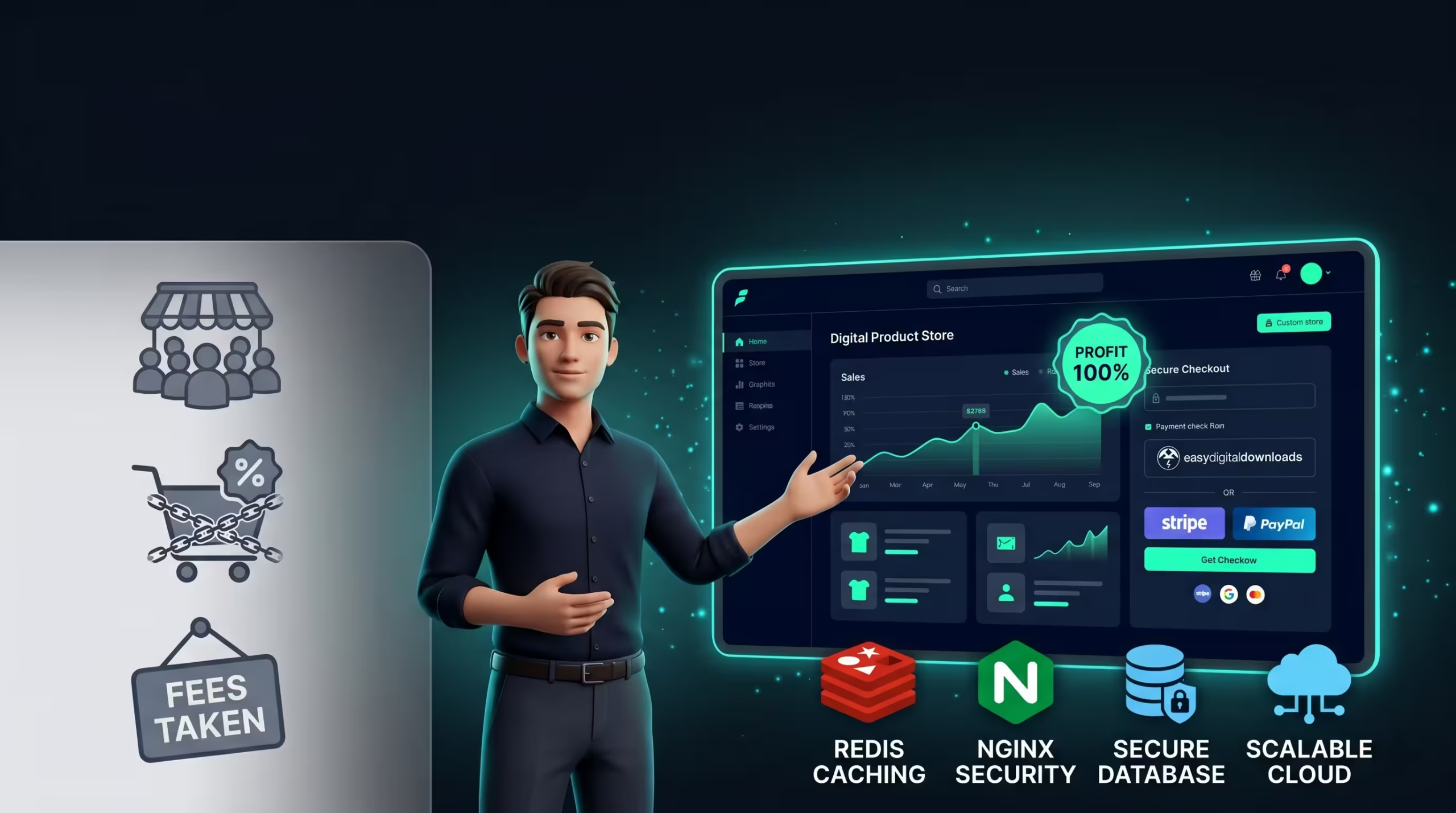
Marketplaces are not your business partners. They are digital landlords actively weaponizing your hard-earned customer data to promote your direct competitors. As your digital product catalog grows, the transaction fees taken by third-party platforms transition from a minor convenience tax to a massive capital drain.
My team and I have audited dozens of high-volume digital creators who eventually hit a hard revenue ceiling. They realized they were functioning as glorified employees for platforms that completely owned their audience. Transitioning to a self-hosted, independent ecosystem is the only logical move for long-term business survival and scalability.
In this architectural breakdown, I will map out the seven absolute advantages of migrating your digital assets to your own infrastructure. We will look past the basic marketing advice and dissect both the raw financial benefits and the underlying server engineering that makes a custom setup vastly superior.
Why Relying on Third-Party Marketplaces is a Massive Business Risk
The Illusion of “Free Traffic” on Marketplaces
Marketplace traffic is never free because it is heavily subsidized by your profit margins and completely controlled by opaque, shifting algorithms. Many creators justify 10% to 30% platform fees by citing the built-in audience discovery. This is a dangerous miscalculation for enterprise scaling.
When you host digital downloads on a shared platform, your visibility is entirely at the mercy of their internal search parameters. A minor, unannounced update to their ranking engine can bury your best-selling assets overnight. You do not own the traffic funnel or the user journey.
You are merely renting visibility on a crowded shelf. The platform actively displays cheaper alternatives right beneath your premium product. This structure forces a race to the bottom, commoditizing your hard work and draining your brand equity.
The Threat of Sudden Account Suspensions
Sudden account suspensions on third-party platforms can instantly eliminate your entire digital revenue stream without warning or an immediate appeals process. Automated moderation bots constantly scan marketplace listings for arbitrary policy violations. These automated systems are notorious for generating false positives.
I have witnessed established B2B creators lose access to six-figure monthly revenues simply because an algorithmic glitch flagged a standard design template or code snippet. When your entire product catalog is gated behind a platform ecosystem you do not control, you operate with zero leverage.
Building your own web architecture completely neutralizes this existential threat. When you utilize an independent Content Management System paired with a robust digital delivery tool, you own the MySQL database. You control the DNS records. You hold root access to the server. No automated marketplace bot can shut down a sovereign server architecture that you fully command.
Advantage 1: 100% Profit Retention Without Hidden Fees
Profit Simulation: Marketplace vs. Self-Hosted Infrastructure
Self-hosted infrastructure allows digital creators to retain 100% of their product margins by eliminating standard marketplace commissions that typically range from 10% to 30% per transaction. Let us look at the raw financial data. If you sell 1,000 licenses of a premium UI kit priced at $100, the gross revenue is $100,000.
On a typical third-party platform, a 20% commission instantly strips away $20,000. Add hidden payout fees and forced promotional discounts, and your actual take-home pay shrinks drastically. By migrating to a standalone server environment, the only structural costs are your web hosting and standard payment gateway processing fees.
Here is the exact data mapping of that scenario:
- Gross Sales: 1,000 units at $100 ($100,000 Total)
- Marketplace Cut (Average 20%): -$20,000
- Self-Hosted Server & Gateway Cost (Stripe 2.9% + 30¢): -$3,200
- Net Profit Difference: +$16,800 retained on your own site.
Maximizing Margins for Scalable Reinvestment
Retaining full profit margins enables digital businesses to aggressively reinvest capital into customer acquisition, server architecture, and advanced feature development. That recovered $16,800 is not just extra income. It is the exact fuel required to scale your enterprise operations. My team constantly sees agencies fail to break the six-figure mark because their margins are too thin to run profitable advertising campaigns.
When you control the payment node, you can direct that recovered capital toward high-ROI channels. Instead of paying a perpetual tax to a marketplace, you can allocate those funds to hire an Easy Digital Downloads Developer. Custom engineering ensures your checkout flow is hyper-optimized for conversions, fundamentally increasing your revenue floor without relying on organic marketplace algorithms.
Advantage 2: Absolute Control Over Customer Data & Retention
Customer Data is Your Ultimate Business Asset
Owning a self-hosted digital product website grants direct access to first-party customer data, including unmasked email addresses and complete transaction histories, which third-party marketplaces actively restrict. Marketplaces view buyers as their customers, not yours. When a transaction occurs on a hosted platform, the system deliberately obfuscates the buyer email and blocks direct communication.
You are completely locked out of building a sustainable relationship with the people purchasing your assets. First-party data is the most valuable asset in any B2B ecosystem. Operating on your own domain means every single checkout node captures the buyer data directly into your CRM or WordPress database. You own the relationship from the first interaction to the final secure download.
Engineering Automated Email Marketing & Repeat Orders
Direct ownership of customer data allows businesses to architect automated email sequences that drive repeat purchases with zero additional customer acquisition cost. Launching a new product on a marketplace requires fighting the algorithm from scratch every single time. Launching on your own platform means instantly broadcasting to a warm list of proven buyers.
This shifts your business model from unpredictable algorithmic dependency to predictable revenue generation. I always architect my systems to trigger highly specific post-purchase automation. If a user buys a React template, the server automatically tags them and drops them into an upsell sequence for a Next.js expansion pack. This engineering logic guarantees high conversion rates because you are targeting users who already trust your code quality.
Advantage 3: Infrastructure Scalability & Uncapped Performance
Preventing Downtime During High-Volume Traffic Spikes
A custom digital product architecture provides root server access, allowing system administrators to dynamically allocate CPU and RAM resources to prevent checkout failures during peak traffic events. Launch days on shared platforms often result in throttled bandwidth and frustrating timeouts for your buyers. When you manage your own WordPress ecosystem, you dictate the server environment completely.
My team provisions dedicated cloud instances that scale horizontally. If an email marketing campaign goes viral and drives thousands of users to your site, the infrastructure automatically spins up additional resources to handle the concurrent connections. You never have to worry about a marketplace server crashing and ruining your highly anticipated product launch.
Speed Secrets: Server-Level Caching & Database Optimization
Implementing server-level caching solutions like Redis and LiteSpeed Web Server dramatically reduces MySQL database queries, ensuring instantaneous file delivery even during simultaneous mass downloads. E-commerce sites require highly specific caching strategies because dynamic cart fragments and authenticated download links cannot be served from a static cache. Heavy concurrent file retrieval will instantly crash a poorly configured Apache server.
I architect enterprise environments using Redis Object Cache to store transient database queries directly in the server memory. We then configure the server rules to bypass PHP workers entirely for static asset delivery. This engineering precision guarantees that when a thousand users click a secure download node at the exact same second, your server processes the requests flawlessly without spiking the CPU load.
Advantage 4: Escaping the Destructive “Price War”
Breaking Free from the Marketplace Red Ocean
Selling digital products on an independent domain removes your assets from direct side-by-side comparison with lower-tier competitors, eliminating the pressure to artificially lower prices. Third-party platforms are structurally designed to prioritize cheaper alternatives and maximize the platform’s overall transaction volume. The interface deliberately surrounds your premium asset with “similar items” that cost a fraction of your price.
This UI choice forces a race to the bottom that destroys your product’s perceived value. Operating your own platform completely isolates the buyer journey. When a visitor lands on your specific URL, they only see your digital products. You effectively monopolize their attention and completely neutralize the red ocean price war.
Establishing Exclusive Brand Authority
A self-hosted infrastructure allows you to position your digital goods as premium enterprise solutions through custom branding, rather than functioning as a generic vendor on a crowded marketplace. Premium pricing absolutely requires a premium environment. You cannot successfully charge enterprise rates for a digital software tool or design system when the surrounding platform UI looks cluttered and amateurish.
By building your own architecture, you control the presentation completely. You establish authority by presenting high-fidelity case studies, interactive technical documentation, and seamless checkout flows. This elevated perceived value allows you to charge significantly more for the exact same digital asset simply because the independent context implies a much higher standard of quality.
Advantage 5: Unrestricted Freedom in Digital File Formats
Scaling Diverse Product Types and File Sizes
Self-hosted digital platforms bypass restrictive marketplace upload limits, enabling creators to distribute massive 3D asset bundles, raw video files, or complex software repositories without constraint. Marketplaces strictly cap your file sizes to save their own server bandwidth and storage costs. This severe limitation often forces developers to split packages awkwardly or rely on unsecure third-party cloud links to deliver the full product.
When you engineer your own server architecture, you define the upload_max_filesize directly within your server’s php.ini file. This grants you the operational freedom to sell massive 4K video courses or multi-gigabyte uncompiled code bases. We routinely connect these self-hosted environments directly to secure AWS S3 buckets or DigitalOcean Spaces, ensuring that massive file deliveries do not impact the core web server performance.
Securing Assets with Encrypted Link Expiration Systems
A standalone architecture automatically encrypts digital files and restricts download limits through unique cryptographic links to combat digital piracy effectively. Protecting your intellectual property on a shared platform is nearly impossible once the buyer gains access to the core file repository. Custom systems allow us to engineer forced, secure URLs that automatically expire after a set duration or a highly specific number of clicks.
My team specifically configures the server file permissions at the Nginx level to block all direct browser access to the protected uploads directory. We route every single download request through a backend PHP authentication script. This script verifies the user’s session token and purchase history in the database before releasing the data packet, making direct file sharing practically impossible.
Advantage 6: Absolute Freedom in UI/UX & Landing Page Design
The Anatomy of a High-Converting B2B Landing Page
High-converting B2B landing pages direct user attention flawlessly from the headline to the checkout node without visual distractions or external marketplace links. On a third-party marketplace, you are tightly confined to a rigid template structure designed to keep users browsing the platform rather than buying your specific item. A sovereign architecture lets you dictate the exact Document Object Model (DOM) flow for maximum conversion velocity.
We build custom sales environments where the user journey is completely frictionless and highly intentional. By completely removing global navigation headers and footer links on the checkout node, we eliminate escape routes. This psychological design forces the user to focus solely on the secure payment gateway, drastically reducing cart abandonment rates.
The Role of Micro-Interactions in Premium Positioning
Utilizing vanilla JavaScript and native CSS for lightweight micro-interactions establishes enterprise credibility while maintaining rapid page load speeds. Premium B2B audiences judge the quality of your digital product by the technical execution of the website hosting it. I always advise utilizing high-fidelity 3D renders to project corporate authority, replacing generic, cartoonish vector illustrations that scream amateur.
We then map these visual assets to hardware-accelerated CSS transitions triggered seamlessly by the Intersection Observer API. This specific engineering delivers a futuristic, tactile browsing experience that feels like a native application. It achieves this high-end aesthetic without the heavy DOM bloat and JavaScript execution delays typically associated with clunky page builder animations.
The Direct Translation Dictionary
Migrating to your own server means translating frustrating platform limitations into absolute code freedom. The UI card below maps the exact visual constraints of shared platforms to the CSS properties you unlock on a sovereign architecture.
UI Architecture Breakdown
Mapping Marketplace Restrictions to Native CSS Freedom
Advantage 7: Architecting Custom Upsell Ecosystems & Funnels
Maximizing Average Order Value (AOV) with Order Bumps
Deploying custom order bumps and one-click upsells directly at the checkout node immediately increases the Average Order Value (AOV) by capturing buyers at their absolute highest point of intent. Third-party platforms utilize checkout pages to cross-sell products from other vendors, actively diluting your potential revenue. A sovereign architecture allows you to engineer the checkout flow to exclusively benefit your bottom line.
When my team architects an e-commerce ecosystem, we manipulate the checkout DOM to inject highly relevant complementary products. If a user is purchasing a core software license, we present an inline toggle for a premium support package right above the credit card input field. This specific engineering tactic consistently generates a 15% to 25% revenue bump per transaction with zero additional marketing spend.
Precision Pixel Tracking for High-ROI Retargeting
Implementing server-side pixel tracking guarantees accurate conversion data for high-ROI retargeting campaigns by completely bypassing browser-level ad blockers. Marketplaces offer heavily restricted analytics dashboards that leave you blind to actual user behavior. You cannot accurately measure cost-per-acquisition (CPA) when the platform strips away crucial referral data.
Owning the server environment means you control the data pipeline. We implement robust server-side tagging to send conversion events directly from the PHP backend to Meta or Google Ads APIs. This technical precision ensures your advertising algorithms receive perfect data sets, allowing you to scale paid acquisition campaigns aggressively and profitably.
Reclaiming Your Digital Business Independence
Transitioning your digital assets from rented marketplace space to a sovereign, self-hosted infrastructure is a mandatory evolution for enterprise scalability. You instantly reclaim massive profit margins, secure invaluable first-party customer data, and establish a premium brand authority that commands higher pricing. Relying on unpredictable platform algorithms is a massive business risk. Owning your server architecture guarantees complete control over your technical performance and revenue streams.
Building a fast, secure, and high-converting standalone e-commerce architecture requires highly specialized technical engineering. You need a system built for speed, security, and scalable revenue generation. To start building your sovereign platform, explore my professional Easy Digital Downloads Development Services to architect an enterprise-grade digital product ecosystem tailored for B2B growth.
Frequently Asked Questions (FAQ)
1. What server architecture is required for selling large digital files? Distributing large digital files requires a High-Availability (HA) cloud architecture paired with an object storage solution like Amazon S3 or DigitalOcean Spaces. This setup prevents the core web server from exhausting its PHP memory limit when multiple users request massive downloads simultaneously.
2. How does Easy Digital Downloads compare to WooCommerce for digital assets? Easy Digital Downloads is engineered specifically for non-physical products, resulting in a significantly lighter database footprint and faster checkout routing. WooCommerce carries heavy legacy code for physical shipping and inventory management, which bloats the DOM and slows down digital-only storefronts.
3. Can I migrate my existing customer data from a marketplace to a self-hosted site? Most marketplaces restrict direct access to full customer emails. However, you can export available transaction histories and incentivize past buyers to register on your new platform through targeted social media campaigns or exclusive product updates.
4. How do I prevent users from sharing direct download links? A properly configured self-hosted platform utilizes cryptographic URL generation. The server Nginx rules block direct folder access, and the backend application generates unique, time-sensitive download links that expire after a specific timeframe or click limit.
5. Is a dedicated IP necessary for hosting digital products? A dedicated IP is highly recommended for enterprise e-commerce environments. It isolates your server reputation, ensuring crucial transactional emails reach the primary inbox and securing your SSL certificate deployment at the server level.
6. What payment gateways integrate best with self-hosted digital platforms? Stripe and PayPal are the absolute industry standards for digital delivery platforms. Stripe offers superior API documentation for custom DOM checkout integration, allowing developers to keep users entirely on-site during the payment process.
7. How does server-side caching affect authenticated digital downloads? Aggressive page caching will break e-commerce checkout nodes and expose secure download links to unauthorized users. You must configure precise cache bypass rules in Nginx or LiteSpeed to exclude cart, checkout, and account endpoints from the static cache layer.

Initiate Secure Comms
Join elite B2B founders receiving my private WordPress architecture blueprints directly to their inbox. No spam, pure engineering.