
The Agency Trap: Why Building an In-House Dev Team is a Financial Sinkhole
Building an in-house WordPress development team drains agency margins by converting variable project costs into fixed overhead, specifically through unbillable bench time, continuous training on evolving stacks, and high turnover rates. Agency owners often mistake headcount for scalability, ignoring the mathematical reality that a full-time mid-level developer costs significantly more when factoring in taxes, software licenses, and idle weeks between client closures.

Crawling through the trenches from door-to-door sales in 2004 to global platforms like Toptal, I have watched countless digital agencies fall into this exact trap. Now, as I focus on building my own enterprise platforms like remyracle, APEL, and the upcoming uxmoxi, I look back at the traditional agency model and see massive financial leaks. CEOs want the prestige of a crowded office, but developers are not assembly-line workers. They are expensive assets that depreciate the moment they are not billing hours.
I need to be brutally honest with you: I only started embracing Elementor about five years ago. For the longest time, I was an absolute purist, stubbornly obsessed with hardcoding custom web solutions from scratch. I thought page builders were for amateurs. I was wrong. Seeing how Elementor Pro 3.35.1 handles complex dynamic data relationships alongside tools like Crocoblock JetEngine completely shattered my ego. It forced me to realize that modern web development is about rapid, scalable deployment, not gatekeeping code. However, managing these visual site builders at an enterprise scale requires heavy engineering logic, not just drag-and-drop enthusiasm from a junior hire.
Real-world disasters happen when agencies hand complex systems to average in-house teams. I once audited an agency whose profit margin was completely wiped out for an entire quarter because their in-house developer crashed a client’s WooCommerce database during a massive Black Friday campaign. The developer simply forgot to index the meta_key field in the wp_postmeta table while running a custom product query. That single oversight caused a severe table lock, taking the dedicated server down for six agonizing hours. You cannot afford those mistakes.
Standard agency logic says hiring in-house developers protects your intellectual property. The reality is, you are just hoarding expensive payroll liabilities that eat your cash flow while they wait for the next client brief.
The Hidden Costs of Onboarding and Idle Bench Time
Idle bench time, the periods where full-time developers have no active billable client work, accounts for up to 30% of wasted payroll in a standard digital agency. Combined with the 60 to 90-day onboarding period required to familiarize a new hire with your specific tech stack and deployment protocols, the actual ROI of an in-house developer remains mathematically negative for at least the first two quarters of their employment.
When you sign an employment contract, you are not just paying a base salary. You are paying for their learning curve. You are paying them to figure out why a specific plugin conflict is breaking the layout on WordPress 6.9. You are paying for their sick days, their hardware, and their inevitable mistakes on staging servers.
Oh, I almost forgot, you also bear the financial burden of their inefficiencies. If your in-house developer does not deeply understand how wp_options table bloat directly impacts Time to First Byte (TTFB), you are literally paying someone a monthly salary to slowly degrade your clients’ Core Web Vitals. The agency model relies on agility. Tying your cash flow to fixed, full-time salaries limits your ability to pivot, scale, or survive a slow sales month.
The White Label WordPress Developer Advantage: Shifting from Overhead to Profit
Transitioning to a white-label WordPress development model converts fixed payroll overhead into a purely variable cost structure, directly linking development expenses to closed client revenue. Agencies scale their profit margins immediately by eliminating idle bench time, paying only for engineered deliverables executed by senior-level architects without the burden of employee benefits, workstation hardware, or continuous training.
I have navigated this exact financial pivot multiple times throughout my career, from grinding on Fiverr and Upwork to managing enterprise deployments on Toptal. When you are running a lean operation, every dollar trapped in fixed salaries is a dollar you cannot spend on client acquisition. The moment I started conceptualizing my own platforms like digmarket and the upcoming uxmoxi, I realized that agility is the ultimate currency. You do not need a massive in-house team to deliver enterprise-grade web solutions; you need a precise execution mechanism.
By partnering with a white label WordPress developer, you immediately bypass the junior-level learning curve. You are plugging directly into a seasoned engineering brain that already knows how to optimize server-side rendering, manipulate the WordPress REST API, and structure complex Elementor DOM trees without breaking a sweat. You sell the high-ticket project to your client, hand off the technical execution to an invisible partner, and pocket the arbitrage. You act as the strategist and the closer, while the heavy lifting happens seamlessly under your brand name.
Most digital agency owners are operating as glorified HR managers, babysitting junior developers and debugging sloppy PHP code instead of actually closing enterprise deals.
What exactly happens to your margins when you white-label development?
When an agency white-labels its WordPress development, profit margins expand by 35% to 50% per project because the agency permanently eliminates the costs of software licenses, office space, hardware depreciation, and non-billable troubleshooting hours. The financial model shifts immediately from speculative salary investments to guaranteed, project-based arbitrage, ensuring that development costs are only incurred when client revenue is already secured in the bank.
Let me break down the brutal reality of agency mathematics. If you land a complex B2B directory site, an in-house mid-level developer will likely spend their first 30 hours just researching how to properly structure relational databases using Crocoblock JetEngine and Elementor Pro 3.35.1. You are literally paying their hourly rate while they read documentation and test failing hypotheses on a staging server.
When you shift to a white-label model, that experimental phase vanishes. Here is the exact sequence of financial shifts your agency experiences:
- Your payroll liabilities drop to zero for the development department.
- Your software licensing overhead (premium plugins, staging environments, API limits) is entirely absorbed by the technical partner.
- Your project turnaround time decreases radically because the architectural blueprints are already standardized by the white-label expert.
- Your actual gross profit becomes highly predictable, as you operate on fixed-cost delivery agreements rather than estimated, bleeding internal wages.
I have seen agencies double their client capacity in a single quarter simply because they stopped trying to manage the code and started focusing exclusively on client relationships. The deep technical execution becomes my problem to solve, not yours.
Why Elementor V4 and WordPress 6.9 Require Elite Engineering, Not Junior Devs
The architectural shift in WordPress 6.9 and Elementor V4 transforms web development from simple visual assembly into complex React-based state management and advanced DOM manipulation, rendering junior developers a liability for enterprise scaling. Elite engineering is now strictly required to process massive database queries, execute server-side rendering, and maintain strict Core Web Vitals without collapsing the server architecture under concurrent high-traffic loads.
Back in 2004, you could hire a cheap junior developer to stitch together basic PHP templates and call it a day. That era is dead. Today, visual builders have evolved into highly sophisticated engines. I see agency owners hiring entry-level staff because they assume tools like Elementor Pro 3.35.1 are just “drag-and-drop” toys. They fail to understand that the visual interface is merely a wrapper over complex JSON data structures and React components. When you are dealing with WordPress 6.9 enterprise architecture, you are managing deeply nested database relationships, custom post type integrations with Crocoblock JetEngine, and dynamic rendering protocols. A junior developer simply does not possess the algorithmic thinking required to prevent these systems from imploding.
I recently audited a B2B agency portal where a junior dev nested Elementor flexbox containers six levels deep inside a dynamic custom loop grid. The result was a catastrophic DOM tree containing over 4,500 nodes on a single product archive page. This completely bottlenecked the browser’s main thread on mobile devices, dropping their Google Lighthouse performance score to a dismal 12, and the client almost terminated a $50,000 contract due to lost ad conversions. I have written about this more comprehensively in my article: Elementor DOM Reduction: Enterprise Core Web Vitals.
Hiring a junior developer to manage an Elementor V4 enterprise stack is like handing the keys of a Formula 1 car to a teenager who just learned to drive a tractor. They will crash it, and you will pay for the damages.
How does the Elementor Atomic Editor (V4) change agency delivery times?
The Elementor V4 Atomic Editor drastically reduces agency delivery times by rendering UI components natively in React rather than executing heavy, synchronous PHP server reloads, allowing elite architects to deploy complex dynamic templates up to 40% faster. However, this velocity is exclusively realized when the developer possesses a deep understanding of React state lifecycles, advanced CSS grid layouts, and strict DOM optimization to prevent layout thrashing.
When I am engineering platforms like APEL (Aplikasi Pemenangan Eksekutif dan Legislatif) or structuring the backend for digmarket, deployment speed is critical. The new Atomic Editor removes legacy rendering bottlenecks, but it simultaneously acts as a magnifying glass for bad coding practices. If your in-house team does not understand how to utilize Elementor V4 DOM optimization properly, the editor’s speed is completely wasted.
According to the architectural guidelines in the Elementor Developers documentation on the V4 framework, the shift toward a more decoupled, React-driven editing environment requires developers to handle styling and scripts modularly. A junior dev will instinctively load heavy, global CSS/JS assets across the entire site “just to be safe,” immediately destroying your client’s Time to Interactive (TTI) metrics. An elite white-label engineer isolates those assets conditionally, ensuring that the agency delivers a blazing-fast, enterprise-grade product ahead of schedule. You stop paying for trial-and-error debugging and start profiting from precision engineering.
Busting the “Loss of Control” Myth in B2B WordPress Outsourcing
B2B WordPress outsourcing does not result in a loss of control; rather, it replaces chaotic, unstandardized in-house micro-management with strict, process-driven engineering protocols. By leveraging white-label agency partnerships, agency owners regain absolute control over project timelines, budget forecasting, and final deliverables without the operational nightmare of supervising daily code commits or debugging junior developer errors.
Back when I was doing door-to-door sales in 2004, clients wanted to see me physically sitting at a desk to feel like they were in control of the project. Today, I see digital agency CEOs suffering from that exact same archaic mindset. They want physical bodies in an office, confusing physical proximity with technical governance. As I transition my focus toward high-level platforms like APEL and the upcoming uxmoxi, I can confidently tell you that an in-house team often provides nothing but a false sense of security.
I once audited a mid-sized B2B agency where the CEO bragged about his “total control” over his five-person in-house dev team. The reality? I looked under the hood and found them hot-fixing live production sites directly via FTP. They had absolutely zero version control. When a rogue update from a poorly coded third-party add-on for Elementor Pro 3.35.1 corrupted their wp_options table, the entire agency was paralyzed for 48 hours because no one had documented a standardized rollback protocol. That is not control. That is a ticking time bomb waiting to destroy your client relationships.
True agency control is not about watching a junior developer type PHP at a desk; it is about holding an elite engineering partner accountable to a strict Service Level Agreement (SLA) that guarantees a flawless product delivery.
Can a white-label partner integrate into an existing CI/CD pipeline?
Yes, an elite white-label partner seamlessly integrates into an existing CI/CD pipeline by utilizing Git version control, automated staging deployments, and strict code review protocols before merging into production environments. This ensures that the agency retains full repository ownership and deployment oversight, neutralizing any risk associated with external code integration while maintaining absolute architectural integrity for WordPress 6.9 applications.
When agencies transition to white-label agency partnerships, their biggest fear is that the code will be locked away in a black box. That is how cheap freelancers operate, not enterprise engineers. When I step in to handle your overflow, I operate entirely within your infrastructure. You own the GitHub or Bitbucket repository. You own the staging environments. I push code through strict branch management, triggering your automated deployment scripts via WP-CLI and GitHub Actions. You have a 100% transparent audit trail of every single line of code I write.
If you want to understand exactly how I structure these enterprise-grade deployment workflows to eliminate human error entirely, I have written about this more comprehensively in my article: Enterprise WordPress CI/CD Pipeline & Git Implementation. You are not surrendering control to a third party; you are upgrading your deployment infrastructure to an enterprise standard. Instead of waking up to a broken site because an in-house junior edited the functions.php file at 3 AM, you wake up to clean, audited commits that pass automated performance testing before they ever reach the live server.
Security, SLA, and the Reality of Enterprise WordPress Management
Enterprise WordPress management requires strict Service Level Agreements (SLAs), dedicated hardware-level firewalls, and continuous vulnerability patching to prevent catastrophic data breaches and costly downtime. In-house junior developers lack the deep server administration expertise and forensic security knowledge necessary to maintain 99.9% uptime architectures, leaving agency clients highly exposed to automated botnets and zero-day exploits.
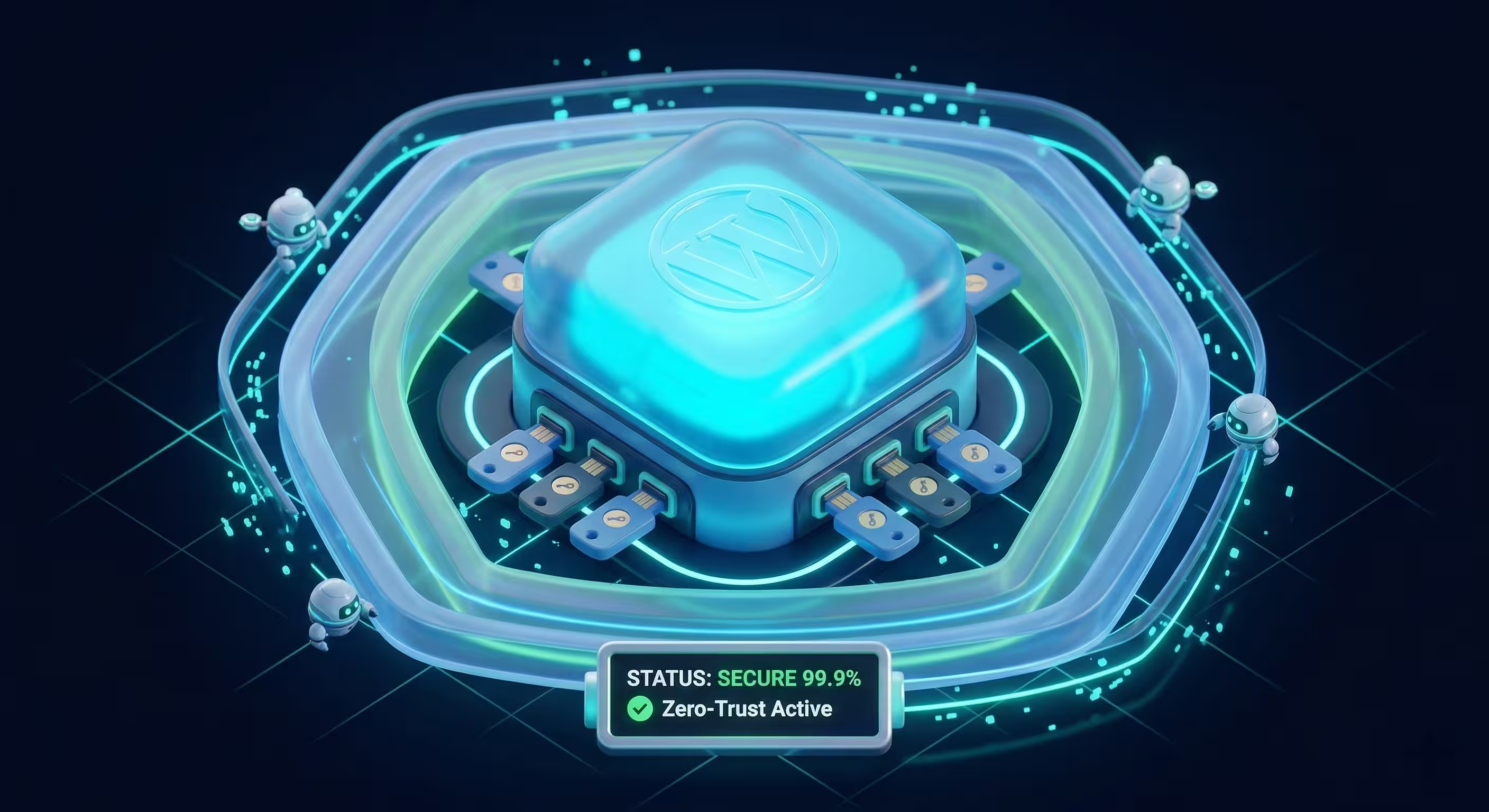
I have repeatedly witnessed agencies sell high-ticket retainers, only to assign server maintenance to the same junior designer who builds their Elementor templates. When I audit this type of architecture, I frequently find unpatched plugins, exposed wp-config.php files, and database user accounts with full root privileges. I once had an agency CEO call me in a panic because a client’s $150,000 B2B portal was hijacked by a crypto-miner malware. Their in-house team spent three days trying to clean the infected files manually via FTP instead of simply spinning up a clean, immutable server backup. The agency lost the account, the retainer, and their reputation in one afternoon.
Managing server-side reliability, caching layers, and maintaining strict WordPress maintenance SLAs is an entirely different discipline from front-end page building. I have written about this more comprehensively in my article: Zero-Downtime WordPress Migration & 99.9% SLA Server Guide. You cannot expect an employee who specializes in CSS animations to properly configure Redis object caching or mitigate a Layer 7 DDoS attack on a multi-tenant WooCommerce instance.
Relying on a junior in-house developer to secure an enterprise WordPress infrastructure is corporate negligence; you are attempting to protect a multi-million dollar client asset with a padlock bought from a dollar store.
Why standard WordPress security is a joke without hardware keys and zero-trust protocols
Standard WordPress security relying solely on passwords and basic two-factor authentication (2FA) applications is fundamentally flawed against targeted phishing attacks and session hijacking. Enterprise security demands zero-trust protocols, hardware security keys enforced via WebAuthn, and strict IP whitelisting at the Nginx or LiteSpeed server level to block unauthorized administrative access before it ever reaches the WordPress login layer.
When I engineer platforms like APEL for political campaigns, where data integrity is literally a matter of national security, I cannot rely on a standard free security plugin to stop targeted scraping bots. Agencies blindly assume that merely keeping WordPress 6.9 and Elementor Pro 3.35.1 updated is enough to secure client data. It is not. If an attacker compromises an in-house developer’s active session cookie while they are logged into a client’s staging site on a public Wi-Fi network, no software-based WordPress plugin will stop the breach. The perimeter is already breached from the inside.
By utilizing elite white-label engineering, your agency inherits a zero-trust architecture by default. I mandate stripping away vulnerable wp-login.php endpoints, enforcing hardware keys for all database SSH access, and implementing strict Content Security Policies (CSP) to prevent cross-site scripting (XSS) injections within the DOM. While an in-house team is busy figuring out how to fix a broken mobile menu, a true technical partner is busy analyzing WAF logs to drop malicious payloads at the edge network. The difference in operational maturity dictates whether your agency scales securely or collapses under liability.
The ROI Math: In-House Salary vs. Strategic White-Label Partnerships
Comparing an in-house salary against a strategic white-label partnership reveals a devastating mathematical truth for agencies: the hidden costs of full-time employment, including taxes, unbillable hours, software licenses, and training, effectively double the advertised base salary of a developer. Transitioning to a white label WordPress developer instantly converts these unpredictable overheads into a fixed, scalable profit margin based strictly on project delivery.
I am going to break down the exact numbers because most agency owners are operating under a dangerous financial delusion. When I transitioned from grinding out projects door-to-door in 2004 to scaling enterprise operations on platforms like Toptal, the defining shift in my profitability was ruthlessly auditing my own burn rate. You think you are paying a mid-level WordPress developer $60,000 a year. You are not. When you factor in the 30% of their time spent idle between projects, the cost of their premium plugin licenses, the hardware, the sick days, and the inevitable debugging hours spent fixing a broken wp_options table, that $60,000 easily balloons into a $90,000 to $110,000 actual cash bleed.
The agency model is built on margin arbitrage. When you hire in-house, you are betting that you can keep that employee 100% utilized, 100% of the time, with 100% perfect execution. It is a statistical impossibility. I once audited an agency that had three full-time junior developers trying to maintain 40 high-traffic WooCommerce sites. They were constantly putting out fires, missing deadlines, and churning clients. They fired all three, hired me as their exclusive technical partner, and their net profit margin spiked by 42% in a single quarter because their fixed payroll dropped to zero.

You are not buying loyalty with a full-time salary; you are buying liability. An elite white-label partnership forces a pure meritocracy where you only pay for flawless, scalable code.
Calculating the true cost of dependency conflicts and database crashes
The true cost of plugin dependency conflicts and database crashes far exceeds the hourly rate of the developer fixing the error; it includes the lost revenue of the client’s downtime, the permanent damage to the agency’s reputation, and the unbillable hours spent forensically restoring corrupted data. A single hour of downtime on an enterprise B2B portal during peak traffic can instantly wipe out a year’s worth of agency retainer fees in client compensation.
This is where the amateur hour ends and enterprise engineering begins. If an in-house developer arbitrarily updates Elementor Pro 3.35.1 and Crocoblock without testing the staging environment’s PHP 8.2 compatibility, they might trigger a fatal error in the wp_postmeta table. The client’s site goes offline. The junior dev spends five hours panic-Googling a fix. That is five hours you are paying for, plus the client’s lost sales, plus the furious phone calls you have to field as the CEO.
When you partner with a seasoned architect handling your backend, these scenarios are aggressively mitigated through strict CI/CD pipelines and automated visual regression testing. The math is simple: an elite white-label developer costs more per hour but requires a fraction of the time to deploy perfectly stable code, eliminating the catastrophic financial risks associated with in-house trial and error.
Financial Burn Rate: In-House vs. Elite White-Label Partner
Strategic Next Steps
Strategic scaling for digital agencies requires immediately halting all in-house developer hiring and transitioning to a variable-cost, white-label engineering model to protect profit margins and guarantee enterprise-level SLAs. Agency owners must stop managing code commits and start managing client acquisition, shifting the technical execution risk entirely to an elite, external architectural partner.
If you are still reading this, you already know the math is not working in your favor. You are tired of being the middleman between demanding enterprise clients and a junior developer who is completely out of their depth trying to optimize a WordPress 6.9 REST API integration. You built your agency to generate wealth, not to run a specialized IT training camp.
My team and I handle the brutal, complex reality of high-traffic database architecture, Elementor V4 DOM manipulation, and stringent security protocols so you never have to look at a staging server log again. It is time to aggressively trim your overhead. Stop paying for idle bench time, keep your enterprise clients happy, and let an engineer who has been building complex web systems since 2004 handle the backend infrastructure.
When you are ready to stop bleeding cash and start deploying enterprise-grade web applications under your own brand, partner with a white label WordPress developer who actually guarantees execution. The technical burden is mine; the profit margin is yours.
Frequently Asked Questions (FAQ)
How do we handle client communication during a white-label project?
@youragency.com email address. My sole responsibility is to architect the WordPress backend, execute the Elementor V4 DOM rendering, and manage the database infrastructure while you retain total control over the strategic client relationship and account billing.Can your white-label team rescue a broken WordPress project started by a junior developer?
wp_options table, untangle the custom post type relationships in Crocoblock JetEngine, and stabilize the server environment before deploying clean, optimized code that meets enterprise SLA standards.How is white-label development billed compared to a full-time in-house salary?
Do you strictly code custom WordPress themes, or do you use page builders?
What level of security and server uptime do you guarantee for my agency clients?

Initiate Secure Comms
Join elite B2B founders receiving my private WordPress architecture blueprints directly to their inbox. No spam, pure engineering.